David Heacock: Boring businesses the government wants you to start
A $23M/month filter business owner pitches government contracts and compliance services as accessible opportunities. The businesses are real. The capital requirements, win rates, and pre-existing infrastructure advantage behind his own success are not part of the pitch.
Source: "Every Boring Business The Government WANTS You To Start" David Heacock, published May 2026. Watch on YouTube →
THE OPPORTUNITY
David Heacock runs Filterbuy, an air filter company he says does $23 million a month. He pitches government contracting as an accessible business opportunity: landing contracts through public bid sites, starting businesses around regulatory compliance requirements, and using tax strategies like S-corp elections and equipment depreciation to reduce tax liability.
HOW IT'S EXECUTED
- Search public procurement sites like Bidnet Direct or sam.gov for contract opportunities in your industry or city.
- Review bid requirements to confirm you can meet them, then submit a proposal before the deadline.
- For compliance-based businesses, identify services businesses are legally required to hire (fire inspections, waste removal, elevator inspections), then obtain the necessary license or certification through a course or exam.
- Start with commercial clients to build revenue history and credibility before bidding on larger municipal contracts.
- Once your side business generates around $60,000 or more annually, file an S-corp election with your accountant to split income into salary and distributions, reducing self-employment tax.
- If your business requires equipment purchases (trucks, machinery), use bonus depreciation or Section 179 deductions to write off a large portion of the cost in year one.
WHAT'S CREDIBLE
Heacock's claim that government agencies post contract opportunities publicly is verifiable. Bidnet Direct and sam.gov exist and do list bids. The S-corp tax election is a real IRS mechanism. Equipment depreciation rules under Section 179 and bonus depreciation are also legitimate tax code provisions. His company, Filterbuy, appears to be a real business with a public online presence. The underlying premise that government agencies must follow procurement rules and consider all qualified bids is accurate. These are documented legal requirements across federal, state, and local jurisdictions.
WHAT'S OMITTED OR OVERSTATED
Heacock says Filterbuy does $23 million a month. That would be $276 million annually for an air filter company. He provides no time horizon, no context for when this figure was reached, and no indication of whether this is gross sales or net revenue. For a company based in Alabama, that scale would make it a significant player in the commercial air filter market. He never explains how the company got to that size or how long it took.
He presents government contracting as straightforward - find a bid, submit a proposal, win. He never addresses bid bonds, performance bonds, or insurance requirements that many government contracts require before you can even submit. Those can run tens of thousands of dollars depending on contract size.
He mentions winning contracts with Houston City Schools and the New York City Subway. He gives no dollar amounts for either contract. He gives no timeline for how long it took to go from starting the business to landing those contracts. He does not say whether Filterbuy was already an established company when those contracts were won or whether those were early wins.
The pitch suggests you can start with no connections and no capital. But he never states what Filterbuy's starting capital was. He never says whether he had prior experience in the air filter industry, distribution, or government sales before starting. A viewer has no way to assess what the actual entry cost or skill floor is.
He says the playing field is "more level than most any other market." But he does not mention that many government bids include scoring criteria that favor existing vendors, past performance history, or local business status. First-time bidders often score lower on evaluation criteria even if their pricing is competitive.
He suggests spending fifteen minutes browsing procurement sites to find business ideas. But he never explains how to evaluate whether a bid represents a viable business or just a one-off contract. Someone with no industry knowledge would have no framework for distinguishing between an opportunity and a dead end.
The compliance-based business model - fire inspections, waste removal, elevator inspections - is presented as a guaranteed revenue stream once you get licensed. He never addresses market saturation, pricing pressure, or how to actually win the first commercial client with no track record. He says a fire inspector in Birmingham serves fifty buildings, but gives no revenue figure, no timeline for how long it took to build that client base, and no cost breakdown for getting certified.
The waste collection pitch suggests starting with commercial accounts to build credibility before bidding on municipal contracts. He does not say how much a garbage truck costs, how much insurance runs, what the ongoing equipment maintenance costs are, or how many accounts you need to cover those fixed costs. He says Filterbuy pays a vendor over a million dollars a year for waste collection. That figure is meaningless without knowing how many locations Filterbuy operates or how much waste volume that represents.
The S-corp election is a real tax strategy. But he presents a hypothetical scenario where a $100,000 side business saves $4,000 a year after accounting for payroll service and accountant fees. He never provides his own actual numbers. He does not explain what "reasonable salary" means in practice or how the IRS determines whether your salary-to-distribution split is defensible.
The equipment depreciation section claims you can write off 100 percent of a truck's cost in year one under current tax rules. That is technically accurate under bonus depreciation rules that were extended through recent tax legislation. But he does not mention that bonus depreciation is currently scheduled to phase down and may not be available at 100 percent indefinitely. He also does not address that you still need the cash to buy the truck in the first place - a tax write-off reduces taxable income, but it is not the same as free money.
He repeatedly says to talk to a CPA before making tax decisions, which is correct. But the framing throughout suggests these strategies are accessible to anyone, when in reality they require a level of income, business structure, and professional support that many side hustlers do not have.
BOTTOM LINE
This is a real category of business opportunity. Government contracts exist, procurement websites are public, and compliance-based businesses do generate recurring revenue. But Heacock's pitch skips over the capital requirements, skill gaps, and competitive realities that determine whether someone can actually execute. The tax strategies are legitimate but only make sense once you are already generating significant business income. This is viable for someone with industry experience, access to startup capital, and the patience to build credibility over time. It is not a shortcut for someone with no money, no skills, and no network, despite how the pitch is framed.
OPPORTUNITY DESK RATING
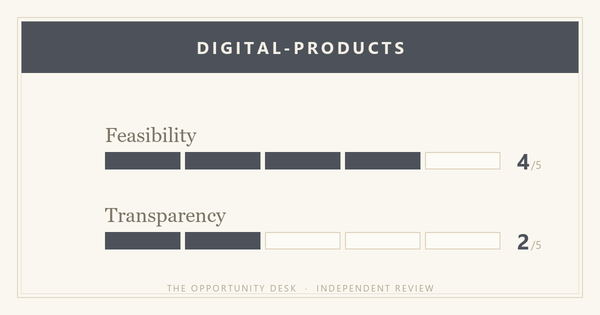
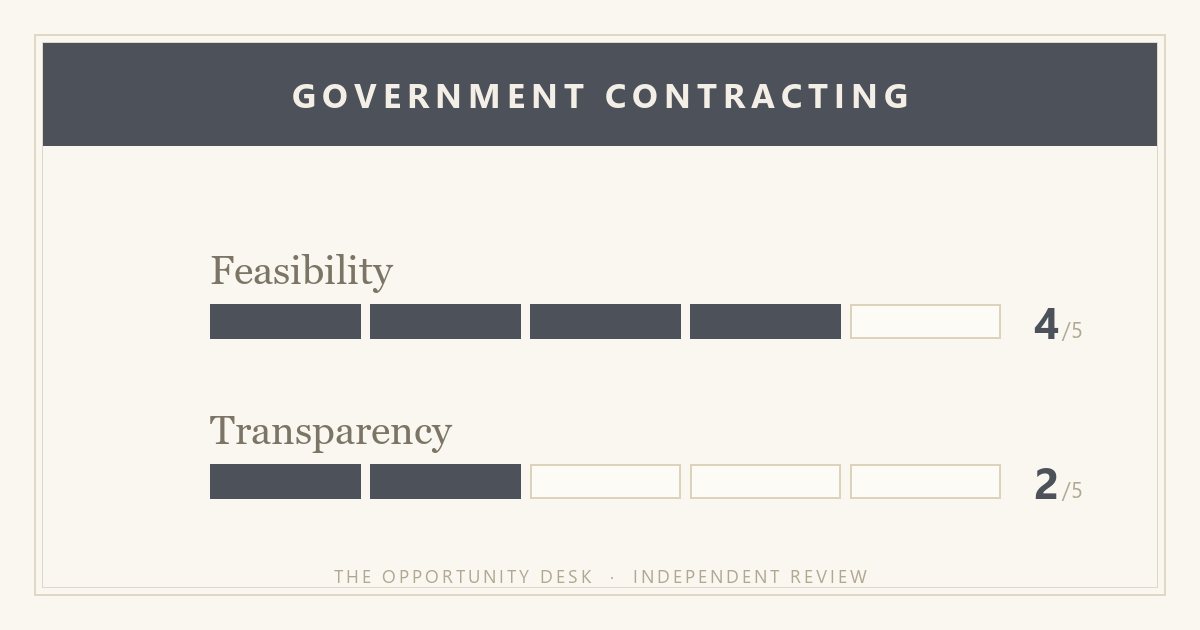
Feasibility: 4/5 — Government contracting and compliance-based businesses are real, recurring revenue models with documented examples across industries. The barriers are navigable but non-trivial.
Transparency: 2/5 — Heacock withholds all the numbers that would let someone evaluate cost, timeline, or realistic income. The $23 million monthly revenue claim for Filterbuy is unverified and presented without context.