Codie Sanchez's "Build a Business with AI in 24 Hours," Reviewed
Codie Sanchez says she built an AI-powered dog leash business from idea to first sale in 24 hours using tools like Lovable, Jasper, and Tidio. She never discloses ad spend, supplier setup, or unit economics, and several of the tools she features are her own products or affiliate partners.

Source: Codie Sanchez, I built a business with AI in 24 hrs. [Watch on YouTube →]
THE OPPORTUNITY
Codie Sanchez walks through building an online dog leash business from idea to first sale using AI tools. She screens trending products, builds a website, writes ad copy, generates branding, and sets up customer service automation — all in about a day.
HOW IT'S EXECUTED
- Use Exploding Topics to identify a product with rising search volume and demonstrated sales.
- Run the product through a three-question filter: recession-resistant, pricing power, technology can improve margins.
- Build a detailed customer avatar using Perplexity for research, ChatGPT for drafting, and Claude for synthesis.
- Generate a website using Lovable, then refine the landing page based on conversion principles.
- Create brand identity and logo using ChatGPT to engineer prompts for Google's Imagen.
- Write ad copy and landing page copy using Jasper, fed with avatar and brand voice.
- Set up Tidio as an AI chatbot to answer customer questions and close sales 24/7.
- Register a domain, launch the site, and run ads to drive traffic.
WHAT'S CREDIBLE
The tools she demonstrates exist and generally work as described. Lovable does build functional websites from prompts, Jasper does generate marketing copy, and Tidio does provide AI chat widgets. The frameworks she shares (the RRT test, villain-victim-vow, cold versus warm traffic) reflect standard marketing principles taught in business schools and practiced in ecommerce. The pet industry spending figure she cites is accurate. Americans do spend over $100 billion annually on pets, and that number has grown consistently.
WHAT'S OMITTED OR OVERSTATED
She shows one order notification but never says how much she spent on ads to get it. Without that number, there's no way to assess profitability. She also doesn't say what the order value was or whether the sale even covered product cost. The "first customer in 24 hours" claim is technically true but misleading. The business model here is dropshipping or print-on-demand, where fulfillment happens through a third-party supplier she never mentions setting up. That integration with a supplier like Printful or a wholesale leash manufacturer would be a material step in the actual execution, but she skips it entirely. She doesn't address product sourcing cost, shipping time, or margin after platform fees. The landing page she built looks polished, but she edits out the part where she would need to connect payment processing, set up Stripe or PayPal, handle sales tax collection, and comply with state business registration. Those aren't optional, they're legal requirements to operate, and they take more than a few clicks.
The video conflates building a website with building a business. A site that can take an order is not the same as a profitable operation. She never mentions customer acquisition cost, lifetime value, return rate, or churn. The one-order notification is not evidence of a sustainable business. It's evidence that one person clicked a button. The brands she uses as examples - Lululemon, premium dog accessories - occupy a market position built on years of customer trust and supply chain relationships. Replicating that aesthetic does not replicate the business fundamentals that make premium pricing stick.
She says the business took 24 hours but clearly spent far more time on this than the video runtime suggests. The editing hides iteration, failed outputs, and rework. AI tools require trial and error. The polished results shown are not first drafts. She also has an existing audience and platform to drive traffic to a new site, which skews the difficulty of customer acquisition downward. A viewer starting from zero would face cold traffic costs she doesn't encounter.
Several of the tools she promotes are sponsors or her own products. BizScout Radar is her company, and she pitches it mid-video as a $199/month subscription. The .online domain segment is a paid promotion. Exploding Topics, Jasper, and Tidio are likely affiliate relationships, though she doesn't disclose that. The economic incentive to recommend those tools over alternatives is never stated.
She presents this as a replicable framework but her starting advantages are significant. She has a production team, video editing resources, a marketing background, and an audience of over a million subscribers. The average viewer trying to replicate this would need to buy ads, which she doesn't budget for. They'd also need to handle customer service, returns, and supplier issues that she outsources to AI tools without testing whether those tools actually resolve complex customer complaints.
The dog leash market she enters is saturated. Hands-free leashes are widely available on Amazon, Etsy, and Chewy at various price points. She doesn't explain how a new entrant with no reviews, no brand history, and no distribution advantages competes on anything other than paid acquisition. If customer acquisition cost exceeds lifetime value, the business loses money on every sale. She never runs that math.
BOTTOM LINE
This works as a tutorial for using AI tools to build marketing assets quickly. It does not work as a tutorial for building a profitable business. The frameworks are sound, the tools are real, but the economics are missing. This is viable for someone who already knows how to run paid acquisition profitably, has capital to test and optimize ad spend, and understands ecommerce unit economics. It is not viable for someone who expects a site and some AI-generated copy to produce sustainable income without those skills.
OPPORTUNITY DESK RATING
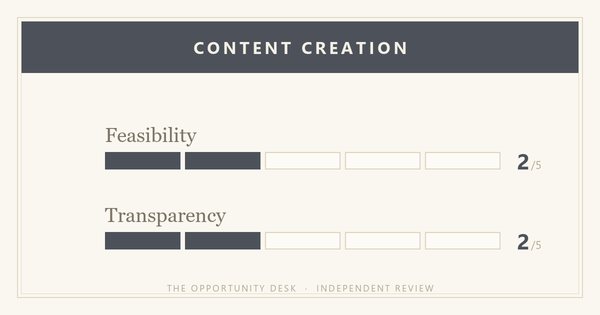
Feasibility: 2/5 — The tools work, but the business model is incomplete. She skips supplier setup, unit economics, and customer acquisition cost, all of which determine whether this makes money.
Transparency: 2/5 — She presents a polished outcome without showing the actual cost, effort, or failure rate. Key affiliations and ownership stakes are buried, and the "24 hours" framing is misleading.