fayefilms, How I make $10,000 a month as a student (and how you can too)
fayefilms pitches five student income streams — freelancing, print-on-demand, tutoring, note-selling, and YouTube — as "non-scammy" alternatives. The $10,000/month headline is never substantiated, and the Etsy math ignores costs entirely.

Source: "How I make $10,000 a month as a STUDENT (and how you can too)" — fayefilms, published December 2025. Watch on YouTube →
THE OPPORTUNITY
The host runs a YouTube channel where she reviews side hustles for students and shares how she earned her first $10,000 selling study notes. She presents five options: freelancing (writing, social media management, design work), starting a print-on-demand business through platforms like Printify, online tutoring, selling study notes, and building a social media presence. She frames these as realistic alternatives to the "watch Netflix for money" scams that dominate TikTok advice.
HOW IT'S EXECUTED
- Choose a skill-based freelance service (copywriting, thumbnail design, social media planning, video editing) and create profiles on Upwork, Fiverr, or LinkedIn.
- Cold-message potential clients through DMs or email, highlighting specific skills and past work in a portfolio.
- Or launch a print-on-demand store by designing products in Canva or Procreate, uploading to Printify, and connecting to Etsy or Shopify.
- Or start tutoring by telling teachers and family you're available, posting in Facebook groups, and charging $20-100 per hour depending on subject and experience.
- Or scan handwritten notes with an app, upload to Google Drive with restricted access, and sell links through Facebook study groups or platforms like StudySoup.
- Build a portfolio or testimonials from early clients to justify higher rates over time.
WHAT'S CREDIBLE
She names a real friend (Ryan) who freelances as a copywriter and charges $1,200 per project as a student, and another friend (Afra) who tutors for $100 per hour and co-founded a tutoring business that turned over $5 million annually. She also discloses her own first YouTube paycheck, which she correctly flags as unusually fast and not representative. The warning about social media income being slow and uncertain is more honest than most creator advice, and the admission that less than 1% of YouTube channels make any money is a useful reality check. Her explanation of print-on-demand mechanics (product made only after purchase, no inventory risk) is accurate.
WHAT'S OMITTED OR OVERSTATED
She claims she earned her first $10,000 as a student by selling notes. She never says how long that took. Six months? Two years? The time horizon matters. She says she had 600 YouTube subscribers when she started selling notes and that her channel "helped boost" her business, but she does not explain how much of that $10,000 came from the YouTube audience versus Facebook groups. If most of the sales came from YouTube, then the model depends on already having an audience, which most students do not have.
She shows an Etsy shop that made 34,000 sales and calculates $920,000 in revenue assuming a $20 average price. She does not subtract Printify's per-item cost, Etsy's fees, or the ad spend required to generate that traffic. Gross revenue is not profit. The "more realistic" example she shows: 4,000 sales in one year, which she presents as $57,000, has the same problem. Without the cost of goods and marketing, those numbers are meaningless. She recommends signing up for Printify Premium at $29 per month because it gives $20 off "everything," which she calls "additional profit." That math only works if you're selling enough units each month that the $20-per-item discount exceeds the $29 fee. She does not specify the sales threshold where that becomes true. She says to use ChatGPT to write product descriptions and SEO keywords. She does not mention that thousands of other sellers are doing the same thing, which means those AI-generated descriptions are increasingly generic and less likely to rank.
She mentions that Ryan charges $1,200 per project but never says how many projects he completes in a month or how long each one takes. One project every two weeks at that rate is $2,400 a month. One per month is $1,200. The income claim is useless without volume. She advises cold-messaging potential clients and says 95% will leave you on read but 5% is worth aiming for. She does not mention that on LinkedIn and Upwork, aggressive cold outreach can get you flagged as spam or suspended if you send too many messages without responses. She describes freelancing as "low barrier to entry" and "competitive" but does not explain how a student with no portfolio competes against established freelancers with verified reviews and lower prices. She shows screenshots of job categories for bilingual speakers and writers but does not address the fact that entry-level freelance rates on Upwork and Fiverr are often below minimum wage once platform fees and revision requests are factored in.
She says Afra charges $100 per hour and co-founded a tutoring business that does $5 million in annual revenue. She does not clarify whether Afra earns that $5 million personally or whether it's the total revenue for a company with multiple tutors and overhead. The distinction is enormous. She recommends offering free tutoring in exchange for being able to promote your notes. She does not mention that many Facebook groups ban self-promotion even after you've contributed, and that free tutoring has an opportunity cost - hours you could have spent on paid work.
She warns against the "watch Netflix for money" scams but positions Printify and note-selling as safe alternatives. Printify is legitimate, but the market is saturated. Note-selling depends on your school not prohibiting it, which she does flag, but she does not address the risk of academic dishonesty accusations if a buyer submits your notes as their own work. She says to turn your notes into physical books using Printify and links to Etsy shops doing this. She does not mention that physical books have higher production costs and longer shipping times than digital downloads, which makes refunds and customer complaints more likely.
She filmed this in Malaysia (ringgit currency, mention of Sky Kiwi platform) but does not clarify whether her income examples apply to viewers in higher cost-of-living countries where $1,200 per project or $100 per hour would be valued differently.
BOTTOM LINE
This is most viable for someone who already has a skill, a small audience, or a personal network willing to refer them. The freelancing and tutoring paths are real, but the income examples need context. How many hours, how many clients, how long to ramp up? The print-on-demand pitch undersells the marketing work required to generate sales and overstates the profit by ignoring per-unit costs. The note-selling model worked for her, but it depends on variables she does not quantify: audience size, subject demand, and school policies. If you have a specific skill and can afford to work for months without guaranteed income, these are legitimate options. If you need money now, the only one with a clear path to cash flow is tutoring, and even that requires hustle to find students.
OPPORTUNITY DESK RATING
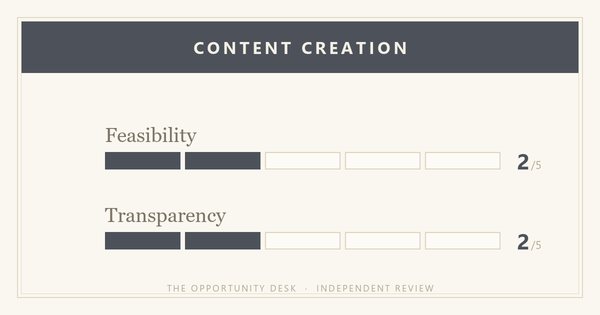
Feasibility: 3/5 — The underlying models (freelancing, tutoring, print-on-demand, selling notes) are real, but the income examples are presented without enough detail to assess whether they're replicable for someone starting from scratch.
Transparency: 2/5 — She names real people and discloses her own slow YouTube earnings, which is honest, but she consistently omits the costs, time horizons, and failure rates that would let a viewer calculate actual viability.