Chris Koerner: $10,000/Month from Government Contracts: No cash? Then it's a good place to start, but it's hard work
A guest claims she clears $10K+ monthly bidding on government contracts and subcontracting the actual work, for about an hour of maintenance per month. The model is real. The compliance risk, the SAM.gov learning curve, and a federal rule that can get you banned are not part of the pitch.
Source: "How Anyone Can Make $10K+/Month From the Government" — Chris Koerner on The Koerner Office Podcast, published May 2026. Watch on YouTube →
THE OPPORTUNITY
Natalie runs a government contracting business. She bids on federal contracts, hires subcontractors to do the work, and keeps the spread between what the government pays her and what she pays them. She says she makes $10,000 to $12,000 a month in profit working about an hour a month once contracts are secured.
HOW IT'S EXECUTED
- Form an LLC and register it on sam.gov, the federal procurement website.
- Search sam.gov for contracts under $350,000 - no past performance is required below that threshold.
- Call subcontractors who can do the work, get quotes, add your markup, and submit a bid.
- If you win, the government pays you first (net 30 or 45 days), then you pay the subcontractor.
- Invoice monthly for ongoing work; most contracts run three to five years.
- Use AI tools like Claude to parse solicitation documents and draft proposals faster.
WHAT'S CREDIBLE
Natalie describes specific contracts with verifiable details - a hazardous waste disposal job in California, a catering contract in Idaho, a landscaping deal in Colorado. She names the federal websites (sam.gov, USA Spending) and mentions PTAC offices, which are real free advisory services funded by the Small Business Administration. The profit margins she cites - doubling a $700 subcontractor quote to $1,500, or marking up $700,000 to $962,000 - are plausible in government procurement, where pricing opacity is common. Her emphasis on reading solicitation requirements carefully and finding hungry subcontractors who communicate well aligns with how government contracting actually works.
WHAT'S OMITTED OR OVERSTATED
She says you need no money to start and can work an hour a month once contracts are running. That omits the capital required to cover operating expenses while waiting 30 to 45 days for government payment. It also omits bonding requirements - many federal contracts require performance bonds, which cost money and require proof of financial capacity that a brand-new LLC with no track record will struggle to obtain.
She won her first contract on her first bid. That is not typical. Government contracting has a steep learning curve. Solicitations are dense, formatting errors disqualify bids, and established contractors with past performance have an advantage. Winning on the first try suggests either unusual luck or advantages she is not disclosing.
She says anything under $350,000 requires no past performance. That is not universal. The $350,000 threshold is a guideline, not a rule. Individual contracting officers have discretion. Many solicitations under that threshold still ask for past performance or prefer vendors with it.
She claims she works an hour a month maintaining her existing contracts. That covers only invoicing. It omits the time spent managing subcontractor performance, responding to government requests for information, handling contract modifications, and dealing with problems when they arise. It also omits the upfront time cost - she says she spent two to three hours a day when actively bidding.
She says you can use a partner's past performance as your own. That is true only if you structure the relationship correctly under federal rules. Teaming agreements and joint ventures have specific legal requirements. A casual handshake arrangement does not count. Misstating your partner's role or performance on a proposal is a federal crime.
She emphasizes that subcontracting is encouraged. That is misleading. The government encourages subcontracting to other small businesses, but there are strict limitations. For service contracts, the prime contractor must perform at least 50 percent of the cost of the contract with its own employees, unless the subcontractor is also a certified small business in the same industry. For general construction, the prime must perform at least 15 percent. She does not mention these limitations-on-subcontracting rules, which are a material constraint on the business model she is describing.
She says felons can do this because they are not on-site. That is only half true. Felons are not automatically barred from federal contracting, but certain crimes - fraud, embezzlement, tax evasion - can result in suspension or debarment from government contracting. A felon who was convicted of defrauding a federal program cannot register on sam.gov.
She describes winning a $962,000 landscaping contract in Colorado after charging $700,000 less than the previous contractor's $1.6 million. She attributes the win to her pricing. She does not explain why the government would award a contract to a first-time landscaping vendor in a state where she has no presence over local established contractors. That suggests either her bid was the only one, or there are set-aside provisions (woman-owned small business, for example) that she benefited from but did not disclose.
She says the government always picks the lowest price if that is the evaluation criterion. That is an oversimplification. Lowest price technically acceptable is one evaluation method, but many contracts use best value, which weighs price against past performance, technical approach, and key personnel. She presents government procurement as more formulaic than it is.
She mentions using AI to draft proposals and sound intelligent about industries she knows nothing about. She does not address the risk. Government proposals require certifications and representations. Misrepresenting your capability or experience is a federal crime. Using AI to fabricate technical expertise you do not have is a shortcut to fraud.
She says startup costs are just an LLC filing fee, internet, and a phone. That omits liability insurance, which many contracts require. It omits accounting software and bookkeeping, which federal contractors need for audits. It omits the cost of bonding, which is often required and can be prohibitively expensive for new businesses with no financials.
The host does not ask for profit-and-loss statements, tax returns, or screenshots of payments received. The income claims are unverified.
BOTTOM LINE
This works if you already understand federal procurement rules, can navigate dense solicitations without making disqualifying errors, and have enough liquidity to float 30 to 45 days of payment lag. It works better if you have a certification (woman-owned, minority-owned, veteran-owned) that qualifies you for set-aside contracts where competition is thinner. Natalie's path - winning on her first bid, landing a $962,000 contract with no landscaping experience, working an hour a month - is not typical. Someone starting from scratch should expect a longer, harder road.
OPPORTUNITY DESK RATING
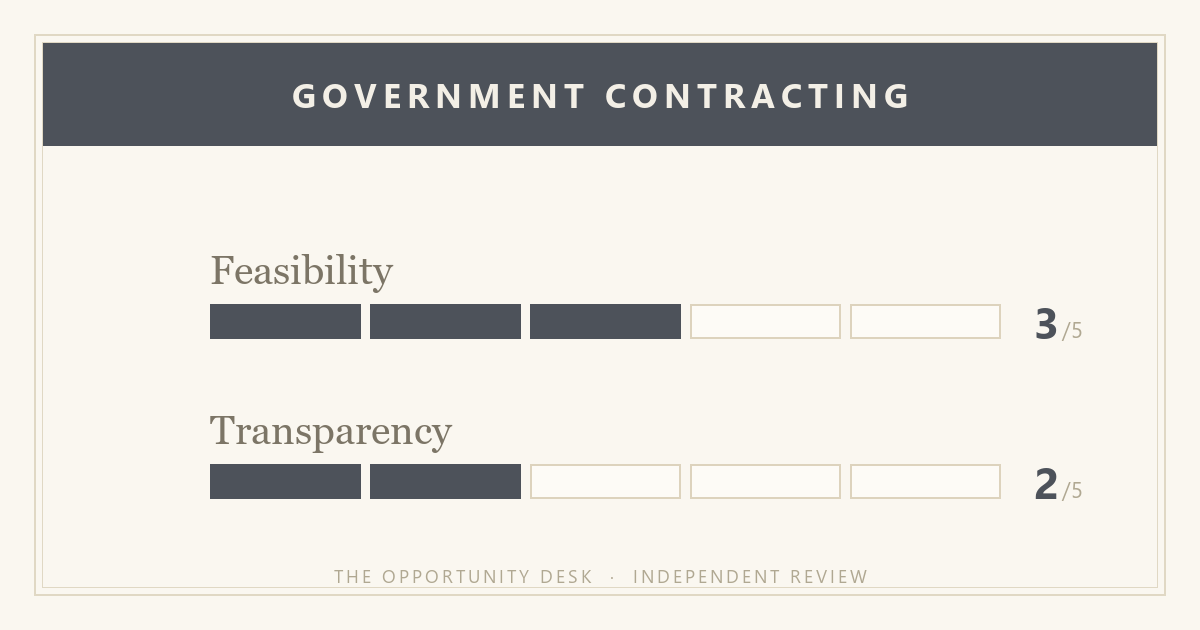
Feasibility: 3/5 — Government contracting is a real business with real revenue, but the barriers are higher than Natalie describes. Bonding, capital, and regulatory complexity make this harder to start than forming an LLC and Googling subcontractors.
Transparency: 2/5 — She omits material rules (limitations on subcontracting, bonding requirements, capital needs) and overstates how easy this is to start. The one-hour-a-month claim is misleading. The lack of financial documentation or verification leaves the income claims unproven.