UpFlip: Is Cara's $192K Furniture Flipping Pitch Legit?
Cara claims $192K/year flipping furniture from her Dallas garage on YouTube. The real number: furniture sales alone bring in $4,000/month, and the AI-staged photos raise questions Facebook's policies don't clearly answer.
Source: "This Mom Makes $192K/Year Fixing Up Old Furniture (From Home)" — UpFlip, published June 2026. Watch on YouTube →
THE OPPORTUNITY
Cara runs a furniture-flipping business from her garage, claiming she makes $16,000 a month from multiple income streams: furniture sales, YouTube ad revenue, sponsorships, and affiliate commissions. She says she started by sourcing old furniture from estate sales, thrift stores, and curbsides, refurbishing it with paint and hardware swaps, then selling it on Facebook Marketplace for significant markups. The pitch is that anyone can replicate this, even without prior refinishing skills.
HOW IT'S EXECUTED
- Source furniture from estate sales, thrift stores, curbside pickups, or Habitat for Humanity ReStores - Cara says she keeps acquisition cost under $80 per piece.
- Clean each piece thoroughly with Simple Green or dish soap to remove decades of wax and grime buildup.
- Sand the surface with an 180-grit orbital sander to prep for paint adhesion, following the wood grain.
- Apply two coats of furniture-grade paint in trending neutral colors (checking Pinterest and Pottery Barn catalogs for what's currently popular), waiting four hours between coats.
- Swap out dated hardware for modern pieces to update the look without stripping and re-staining.
- Stage finished pieces against a shiplap backdrop with decor, photograph with an iPhone, and use AI (ChatGPT) to generate an upscale cover photo for the listing.
- List on Facebook Marketplace with SEO-heavy keywords (buffet, credenza, solid wood, upscale) and detailed dimensions to reduce back-and-forth questions.
- For those pursuing the YouTube angle, film the flip process, monetize ad revenue, secure sponsorships, and earn affiliate commissions from linked products.
WHAT'S CREDIBLE
Cara provides specific dollar figures for her income streams and itemizes her costs in detail: $30 for furniture, $25 for paint, $40 for hardware. She shows actual pieces she's flipped in her own home and walks through the staging setup she uses. The $16,000 monthly revenue figure breaks down into furniture sales ($4,000), YouTube ad revenue ($6,000), sponsorships ($3,000), affiliates ($2,000), and Facebook ads ($1,000), which at least demonstrates she's thought through multiple monetization angles. The UpFlip host physically participates in sourcing, sanding, and painting a dresser, and Cara posts it for $750 a few days later, reporting it sold at full asking price within 24 hours. That sequence gives the viewer something concrete to anchor to rather than vague income claims with no follow-through.
WHAT'S OMITTED OR OVERSTATED
Cara's path to $16,000 a month relies heavily on YouTube - $6,000 in ad revenue plus another $5,000 from sponsorships and affiliates. That's $11,000 of the $16,000 coming from content, not furniture. She mentions her channel was monetized in five months, which is unusually fast. Most YouTube channels take years to reach monetization thresholds, and even fewer secure Lowe's as a top-100 influencer partner or land a Mr. Beast collaboration. Those advantages are presented as natural outgrowths of the furniture business, but they're the result of early virality after a Dave Ramsey feature - a media break that the average viewer cannot replicate.
The furniture-only income is $4,000 a month. Cara says she flips five to six pieces a week at the business's peak and currently sources about five pieces a month. She spends up to $80 per piece on furniture and around $300 on supplies - roughly $700 in direct monthly materials, matching her own on-screen cost breakdown. She lists $2,160 in monthly employee costs, which she attributes to managing social media, not furniture production. If those employees are fully allocated to the furniture side of the business rather than the content side, the actual furniture net is closer to $1,140 a month after materials and staff costs, not $4,000.
She says most pieces sell in 24 to 48 hours. But she also acknowledges slower seasons around holidays, graduations, and summer. She lists the dresser they flipped together for $750 and says it had three interested buyers and sold within 24 hours during Memorial Day weekend, which she had just described as a slow period. Either the piece sold unusually fast for a slow season, or the "24 to 48 hours" claim understates how quickly a well-staged piece can move even during supposedly slow months - either way, the two claims seem to conflict.
The ChatGPT staging trick for cover photos is presented as a selling advantage, but Cara admits buyers are "getting savvy" to AI staging. That means the tactic's effectiveness is already eroding. She also says she provides multiple real photos after the AI cover image to prove the piece is legitimate. If buyers distrust the AI image enough that she needs to counterbalance it with real photos, the AI staging may be creating skepticism rather than stopping the scroll.
Cara says she paid $11 for a full china hutch at an estate sale and sold the two pieces separately for over $3,000 combined. She describes estate sales as online bidding where items "usually sell for really low" and mentions pieces being "left behind" after the sale ends. That $11 price suggests she's not winning competitive bids but rather buying unclaimed remnants after the sale closes. The audience won't have the same success if they're bidding against other flippers during the actual sale window.
She says she keeps acquisition cost under $80 per piece and flips five pieces a month, budgeting around $400 in monthly furniture spend. But she also describes buying four or five pieces at a time from estate sales to "stock the garage for the month." If she's batch-buying and those pieces vary widely in condition, some will require more prep time or yield lower margins than the $665 profit on the dresser they flipped together. She doesn't provide a range of outcomes - only the best-case flips.
The $110 per hour figure assumes six hours of hands-on work per flip and a $665 profit. It ignores drive time to source pieces, time spent photographing and listing, time managing buyer inquiries on Facebook Marketplace, and time arranging pickup. Cara says she spends "two to three hours a day on a flip" over three days due to dry time. That's six to nine hours of calendar time per piece, not six hours of active work. The hourly rate calculation cherry-picks only the profitable labor hours.
She mentions needing safety gear (masks, goggles, closed-toe shoes) and specific tools (orbital sander, paintbrush, furniture-grade paint). She also describes cleaning with Simple Green, sanding with 180-grit pads, using a paint sprayer with adjustable settings, swapping hardware, and sometimes stripping and re-staining tops for two-tone finishes. For someone who "didn't know how to do it at all" and learned everything from YouTube, the skill progression from zero to consistently selling pieces for $800-$1,200 in under six months is glossed over. No mention of failed flips, pieces that didn't sell, or money lost on mistakes during that trial-and-error period.
BOTTOM LINE
This works as a furniture-flipping side hustle if you have access to cheap inventory, a garage workspace, and a local market willing to pay $650-$1,200 for refurbished pieces. Cara's $4,000 a month in furniture-only revenue is possible, but her $16,000 a month total depends on YouTube monetization and brand partnerships that most viewers will never secure. If you're evaluating this as a furniture business, ignore the YouTube income entirely and assume you'll make closer to $1,000-$2,000 a month after costs once you account for slower seasons, pieces that don't sell quickly, and time spent sourcing and managing buyers. The skill floor is lower than Cara suggests, sanding and painting are learnable, but the income ceiling without a media platform is far below what the video's headline implies.
OPPORTUNITY DESK RATING
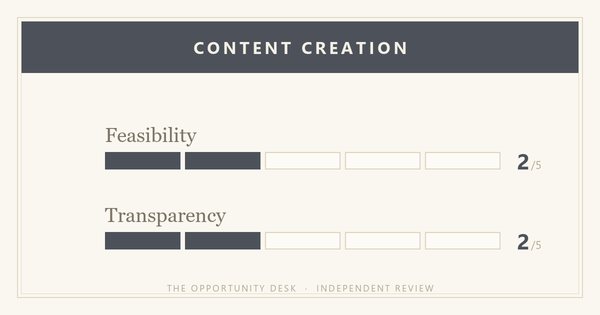
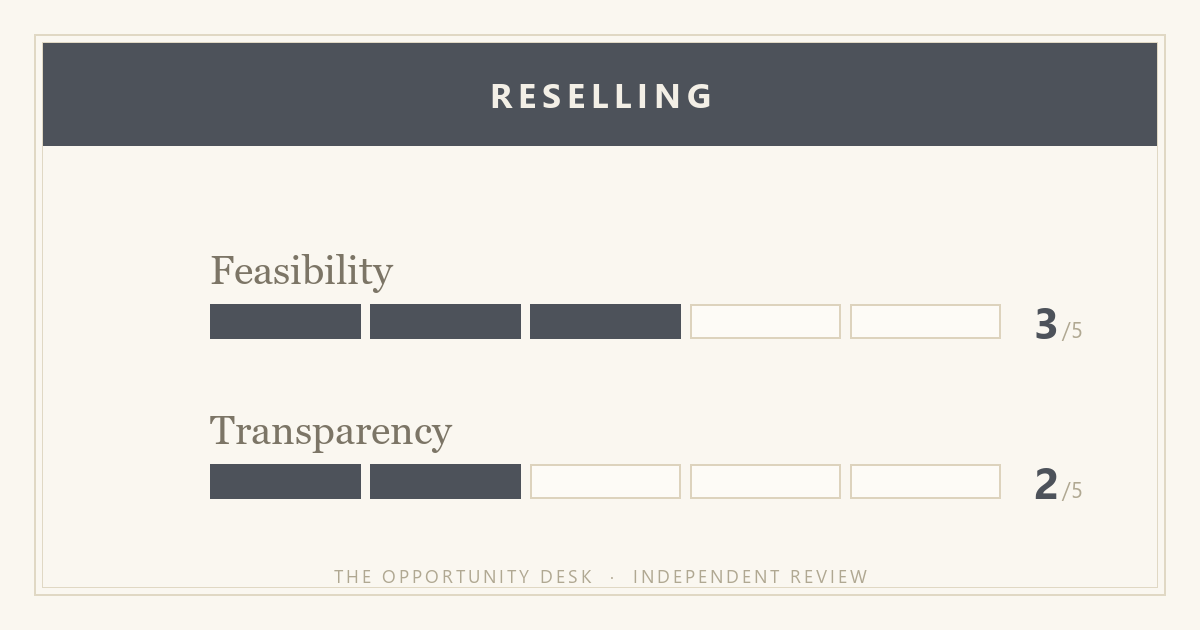
Feasibility: 3/5
The furniture-flipping mechanics are sound, but the income relies heavily on YouTube monetization and sponsorships that are not accessible to most beginners. The $4,000 monthly furniture revenue is plausible in a strong local market, but the $16,000 total is misleading for anyone not building a content business alongside the flipping.
Transparency: 2/5
Cara provides detailed cost breakdowns, but she conflates furniture income with content income throughout the video and doesn't clearly separate the two until pressed. The $110 per hour calculation omits non-labor time, the 24-48 hour sale timeline is presented as typical without acknowledging seasonal variability, and her early virality (Dave Ramsey feature, Lowe's partnership, Mr. Beast collaboration) is treated as replicable rather than exceptional luck.