Is Jordan Welch's Claude AI Drop-Shipping Model Legit? His $102K Claim, Rated
Jordan Welch says a 17-year-old used Claude AI, Shopify, and Facebook ads to turn under $100 into $102,000 in sales in 90 days. That figure is gross sales, not profit, and the margins, ad spend, and starting capital that made it possible go unstated.
Source: "How I Used Claude AI To Make $102k In 90 Days" — Jordan Welch, published July 2026. Watch on YouTube →
THE OPPORTUNITY
Welch pitches using AI tools (primarily Claude, Shopify, and an image generator Higgsfield) to build and run a drop-shipping store selling niche products. The claim: a 17-year-old subscriber with under $100 starting capital made $102,000 in sales in 90 days, scaling to $200,000 in six months, working 30 minutes daily. The model: use AI to build the store, find products, write copy, and generate ad creatives, then run Facebook ads to drive traffic.
HOW IT'S EXECUTED
- Sign up for Shopify ($1/month trial for three months), install Welch's free "Build Your Store" AI tool, and select a product category (he demonstrates home/garden).
- Use Claude with a specialized prompt (sourced from "Mark Builds Brands") to research and validate product ideas based on parameters like budget, market traffic data, and competitive analysis.
- Import the selected product from AliExpress into AutoDS (a drop-shipping fulfillment service that sources and ships products directly to customers).
- Use Claude to rewrite the Shopify store's product page code by feeding it the existing JSON file and an Amazon listing of the product.
- Generate product ad images using AI tools, then launch Facebook ads with a $30/day testing budget to drive traffic to the store.
WHAT'S CREDIBLE
He demonstrates actual interface workflows. You watch him use Claude to generate product recommendations and rewrite Shopify code in real time. The core mechanic (drop-shipping with AI-assisted store building and ad creative) is technically feasible and represents an evolution from manual methods. His emphasis on "painful problem" products aligns with established direct-response marketing principles. The acknowledgment that AI simplifies research but doesn't eliminate the need for product selection judgment is more candid than most pitches in this category.
WHAT'S OMITTED OR OVERSTATED
The "$102k in 90 days" headline conflates gross sales with profit or take-home income. Welch never states margins, ad spend, refunds, or net profit from that case study. A drop-shipping store doing $100k in sales might net $10k-$30k after costs, or could lose money if ad spend exceeded margin, and it would be helpful to know which end of that range applies here. The "30 minutes a day" claim is presented without definition. Whether that includes customer service, supplier issues, and ad monitoring, or just initial setup, isn't addressed. The 17-year-old's success story is mentioned but never shown with screenshots, and it's unclear what advantages this person had access to, including mentorship or support from Welch's team. The path shown relies on Welch's proprietary "Build Your Store" tool and a free consultation with his team, and what that consultation involves, including any upsells, isn't disclosed.
Facebook ad success is presented as straightforward ("start getting sales as soon as the next day"), but the testing process, failure rate, and learning curve for profitable ad creative aren't addressed. The claim of launching another store "not even a week ago" to $150 in first-day sales is mentioned without proof or follow-up, and $150 in sales (likely $30-$60 in profit) isn't comparable in scale to the six-figure case study leading the pitch. A single day of sales isn't evidence of a sustained, profitable store.
Separately, the $100 starting-capital claim doesn't square with the $30/day ad budget Welch recommends ($900/month minimum). How the 17-year-old's launch was funded on that budget isn't explained.
BOTTOM LINE
This is viable for someone willing to learn Facebook ad mechanics, customer acquisition math, and supplier management. The AI tools significantly lower the technical barriers to building a store. But the "$102k in 90 days" framing obscures the actual financial outcome and required effort. Success here depends on skills Welch barely addresses: identifying winning ad creatives through iteration, managing ad accounts without getting banned, and scaling profitably. If you lack patience for testing ads and tracking unit economics, the AI tools won't change that.
OPPORTUNITY DESK RATING
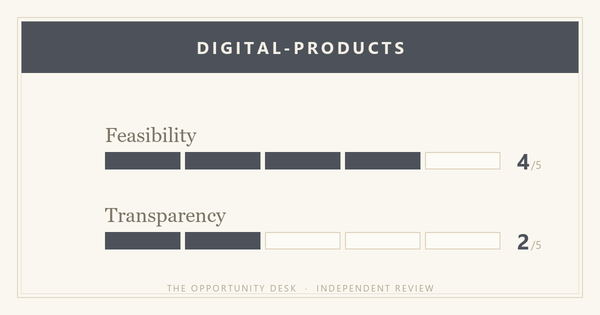
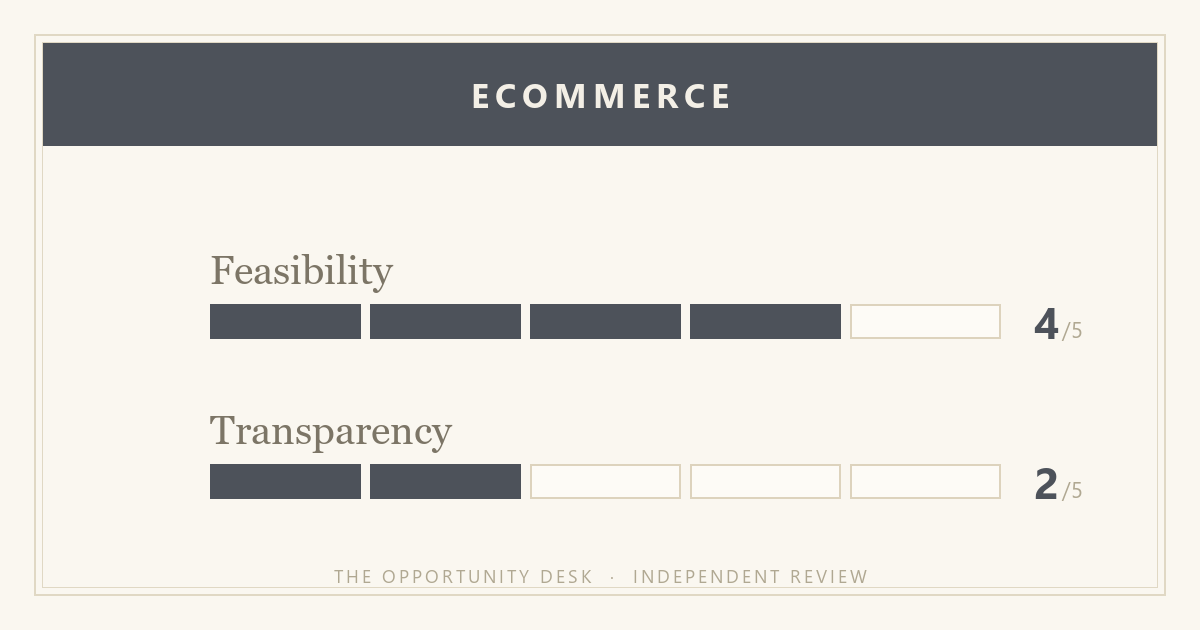
Feasibility: 4/5
Drop-shipping with AI-assisted workflows is a real, functional business model. The tools he demonstrates do lower the barriers to entry, and the product selection framework (painful problem, not in stores, validated demand) is sound.
Transparency: 2/5
Welch conflates gross sales with income, omits costs and workload realities, keeps the success story's details behind a proprietary lead magnet, and presents a $150 first-day sales test as comparable to a six-figure outcome without acknowledging the gap between them.