The Koerner Office: From DoorDash to $81K/M With This Overlooked Business
Parker says he went from DoorDash to $81,000 in monthly revenue in 85 days selling subcontracted water filtration installs. He hasn't taken any profit yet, and his stated $500 startup cost excludes the $950 in equipment and roughly $2,000 in ad spend needed before the first sale.
Source: "From DoorDash to $81K/M With This Overlooked Business" — Chris Koerner on The Koerner Office Podcast, published September 2026. Watch on YouTube →
THE OPPORTUNITY
Parker runs a water filtration business in Raleigh, North Carolina. He says he went from delivering for DoorDash to $81,000 in monthly revenue in 85 days. He subcontracts all installation work to licensed plumbers and says he started with less than $500 in setup costs.
HOW IT'S EXECUTED
- Build a basic website using Claude AI and set up a CRM (Go High Level), scheduling platform (Jobber), and payment processing - total tech stack runs about $300 per month.
- Secure general liability plumbing insurance (roughly $180 per month) even though you're not doing the physical work yourself.
- Recruit licensed plumbers through Indeed job posts offering $75-125 per hour for subcontract work - target plumbers who own small operations and want to stay busier.
- Source water filtration systems (softener tanks, carbon filters, reverse osmosis units) from OEM distributors for about $950 per system plus $100 in miscellaneous fittings and supplies.
- Run Facebook ads with static images showing the installed price ($2,699 in Parker's case) to attract customers who've already been quoted higher prices by established companies.
- Close sales over the phone or text without in-person estimates, then dispatch your subcontracted plumber to install the system at the customer's home.
WHAT'S CREDIBLE
Parker's timeline is verifiable through his social media presence - he's been posting about this business publicly since June 2024. His pricing structure is internally consistent: $2,700 sale price minus $950 in equipment, $500 to the plumber, and $100 in miscellaneous costs leaves roughly $1,150 in gross margin before marketing spend. He acknowledges his customer acquisition cost ($175 per customer by his count) and his close rate (25% of all leads, 35% of leads he actually speaks with), which are specific enough to suggest real tracking rather than invented numbers. The core insight, that established water filtration companies charge $6,000-8,000 for comparable systems, is verifiable through those companies' public pricing and creates an arbitrage opportunity for a lower-cost competitor.
WHAT'S OMITTED OR OVERSTATED
Parker's revenue claims are gross, not net. He says he hasn't taken "a dime" in profit because he's reinvesting everything in inventory. That means the $81,000 August figure is sales, not take-home income. His actual operating profit by his own math was closer to $18,000 that month, which is significant, and even that went back into the business. Someone evaluating this needs to know the difference between revenue and profit - the headline number sounds bigger than the actual money available to live on if you need to reinvest in the business.
The $500 startup cost is somewhat misleading. That covers the tech stack and insurance for one month. It doesn't include the $950 for the first system's equipment, which you need before you can fulfill your first sale. It also doesn't include the ad spend required to generate leads. Parker spent roughly $2,000 on ads in June alone. The real startup capital to get one sale completed and start generating cash flow is closer to $3,500-4,000, not $500. And even then, you still need more capital for your next systems, until you have enough retained earnings to self-fund the business.
Parker's customer acquisition cost of $175 is unusually low and he admits he doesn't expect it to stay there. Most home service businesses see CAC in the $300-500 range for this ticket size. If CAC doubles, his net margin drops from roughly 30% to closer to 20%, which is still viable but meaningfully different from the numbers he's presenting now.
His close rate depends entirely on customers already being educated about water filtration. He's explicitly targeting people who've already had in-home consultations with competitors like Culligan or Kinetico. Over 35% of his customers had already received quotes from those companies. That's not a repeatable advantage you can use in a market where those big players aren't active, or where consumers aren't already primed. In a less educated market, you'd need to add the in-home consultation step he's currently skipping, which adds labor cost and time.
Parker's plumber recruitment worked on the first try through Indeed. He got four qualified leads in four days and hired three of them. That's not typical for contractor recruitment, especially in markets with tighter labor supply. He's in Raleigh, a growing metro with a healthy trade workforce. Someone trying this in a rural area or a market where plumbers are already fully booked would face a much harder recruitment process.
The business depends on consistent inventory availability. Parker ran out of stock twice in his first three months, which cost him a full week of installs in August. He now rents a 10x20 storage unit for $125 per month and front-loads inventory, which ties up capital. That's an additional ongoing cost not mentioned in the startup breakdown.
Parker's 52 five-star reviews in 85 days require aggressive review solicitation. He personally follows up with every customer, offers free salt deliveries in exchange for reviews, and asks customers to have their spouses and family members leave reviews as well. That's not unethical, but it's labor-intensive and not everyone will be comfortable with that level of hustle. It's also a practice that could draw scrutiny from Google if it's perceived as review manipulation.
His market, Raleigh, doesn't have severe hard water, which he acknowledges. He's selling primarily on chlorine removal and general filtration rather than solving an acute problem. That makes the sales process easier because the value proposition is less technical, but it also means the total addressable market is smaller. He estimates less than half of Raleigh households would even be interested in a softener. In a market with genuinely hard water, demand would be higher but so would competition.
Parker's background includes two prior home service businesses: a cleaning company he ran for two years and a holiday lighting business he still operates. He's not a first-time operator figuring this out from scratch. He already knew how to set up a CRM, run Facebook ads, recruit subcontractors, and manage customer service before he started this business. Someone without that experience would face a steeper learning curve.
The business model depends on undercutting established players by 60-70% on price. That only works if those players continue to charge $6,000-8,000 and don't adjust down to compete. Maybe they won't, but if Culligan or Kinetico or a regional competitor drops their pricing to match or undercut Parker, his entire positioning collapses. He's betting on incumbent inertia, which is often a safe bet but not a permanent one.
Parker's ad strategy, putting the price directly in the ad, works because he's targeting people who already know what water filtration costs. That's a narrow audience. Meta's algorithm can find them now, but as more competitors enter and bid on the same audience, cost per lead will rise. He's operating in a temporary window of low competition and high price anchoring from incumbents.
BOTTOM LINE
This is viable for someone who already knows how to run a home service business, recruit subcontractors, and manage Facebook ads. The model works because established companies charge 2-3x what the service actually costs to deliver, and Parker is arbitraging that gap. But the $500 startup figure is almost fictional - real startup capital is closer to $4,000 once you include inventory and initial ad spend. The revenue numbers are gross, not net, and Parker himself hasn't taken any profit yet. The customer acquisition cost he's seeing now is unlikely to hold as competition increases. The business depends on a market where big players have already educated consumers and set high price anchors, which limits where this works. Geography matters a lot for his strategy. If you have home service experience, access to $5,000-10,000 in working capital, and you're in a metro area with both hard water and expensive incumbents, this is worth testing. If you're starting from zero experience or trying this in a market without those conditions, the path is much harder than the episode suggests.
OPPORTUNITY DESK RATING
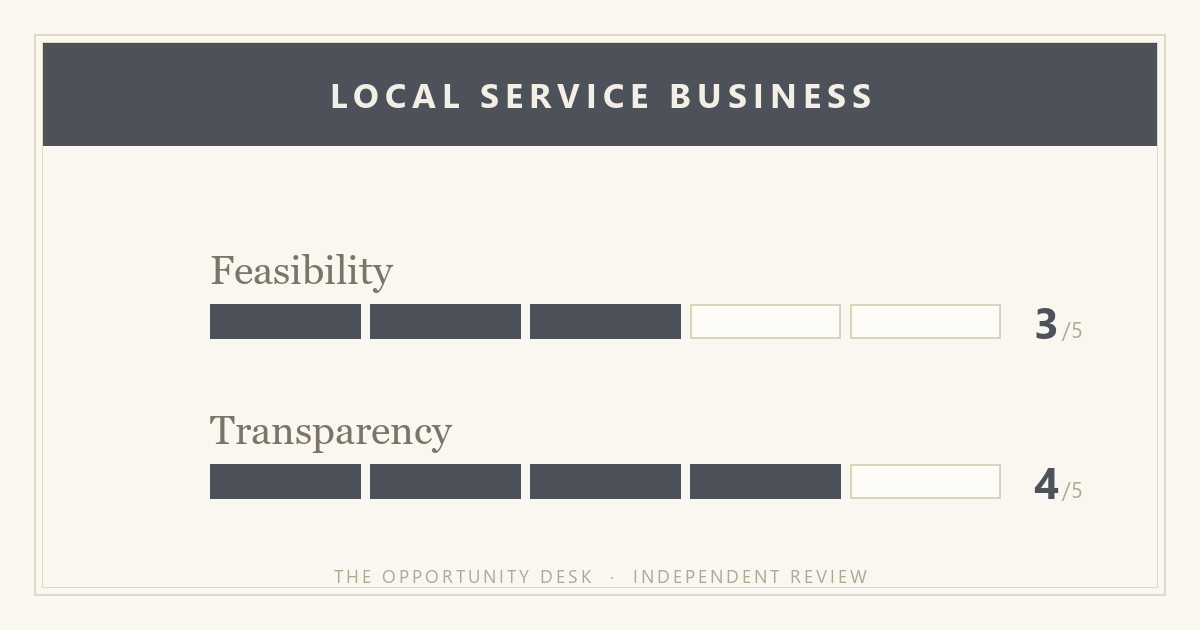
Feasibility: 3/5 — Parker says he started this business with "less than $500" and was live in three weeks, but that figure covers only the tech stack and insurance for one month - it excludes the $950 for the first system's equipment, the $2,000 in ad spend he used in June, and the storage unit he now rents for inventory. The model is replicable for someone with home service experience and $5,000-10,000 in working capital, but the stated startup cost omits the actual capital required to fulfill a sale and generate leads, and the business depends on a market structure (expensive incumbents, educated consumers) that doesn't exist everywhere.
Transparency: 4/5 — Parker discloses his gross revenue ($81,000 in August), his cost structure ($950 equipment, $500 to plumber, $100 miscellaneous per job), his customer acquisition cost ($175 per lead), and his close rate (25% of all leads), and he acknowledges he hasn't taken any profit yet because he's reinvesting in inventory. Core numbers are specific and timeframes are clear, and Parker acknowledges material caveats like his prior business experience and the unsustainably low CAC, though he doesn't flag that over a third of his customers were pre-educated by competitors or that his $500 startup figure excludes the capital actually needed to operate.