Alex Hormozi: How I Would Build a $10M Service Business (If I Had to Start Over)
Source: "How I Would Build a $10M Service Business (If I Had to Start Over)" — Alex Hormozi, published August 2026. Watch on YouTube →
THE OPPORTUNITY
Alex Hormozi coaches Kaleb, who runs a two-month-old roofing company in St. Louis, on scaling from $41,000 in revenue to $7-10 million within three years. Hormozi's advice centers on shifting focus from full roof replacements to high-volume repairs, building a door-to-door sales team, and adding upsell mechanisms through scripted follow-up calls and video sales letters.
HOW IT'S EXECUTED
- Shift your primary offering from full roof replacements (average ticket $18-25K) to repairs and smaller jobs (average ticket $1,500-5,000), which competitors ignore but can be sold at higher volume.
- Scale door-to-door canvassing as the sole customer acquisition channel. Kaleb claims he closes one sale per 20 doors knocked.
- Deploy two video sales letters: one shown on-site to frame the repair as part of a larger roofing investment, another shown before a follow-up call to set up upsells on additional services.
- Hire an inside sales closer who follows a menu close script: unsell what the customer doesn't need to build trust, prescribe what they do need, offer binary choices to simplify the close, and charge the card on file.
- Add a speed incentive (20% upcharge to jump the queue) and a maintenance membership ($180-240/year, credited toward future repairs) to increase margin and create recurring revenue.
- Hire additional door-knockers and a dedicated repair technician to handle 3-5 jobs per day, scaling service delivery in parallel with sales volume.
WHAT'S CREDIBLE
Kaleb's claim that he closes one sale per 20 doors knocked is specific and testable. If accurate, it gives the model a reliable customer acquisition cost baseline. The 90-day follow-up shows revenue increasing from roughly $32,000 to $247,000, which Kaleb attributes to hiring a repair tech, implementing the menu close, and going all-in on door-to-door. The shift from chasing large replacement jobs to high-volume repairs makes sense in a market where competitors won't touch small jobs. That creates real pricing power if the volume claim holds. Hormozi's emphasis on gross profit per transaction rather than revenue alone is sound: a $1,100 gross profit repair sold three times as often as a $7,000 gross profit replacement yields better cash flow and less administrative drag.
WHAT'S OMITTED OR OVERSTATED
The 20-door close rate is presented as Kaleb's current performance, not an average across multiple salespeople or a sustained rate over months. We don't know if that holds when he's not the one knocking.
The revenue jump from $32K to $247K in 90 days is attributed to Hormozi's advice, but Kaleb also mentions implementing a custom ERP system and hiring a repair tech. Those are significant operational changes that would drive revenue independent of any sales script. Notably, at the 90-day check-in Kaleb says he's "shooting the VSSL come next week" meaning one of Hormozi's two centerpiece tactics, the video sales letter, had not even been produced yet when the $247K figure was reported. The revenue jump happened without it. The video doesn't separate which gains came from which change.
The gross profit percentages (59% overall, 64% on repairs) are stated but never reconciled with actual cash flow. We don't know what Kaleb's fixed costs are, what he's paying himself, or whether that 59% margin survives after labor, materials, and overhead.
The menu close and VSSL tactics are presented as if they're plug-and-play, but both require scripting skill, video production, and a closer who can execute without sounding mechanical. Kaleb says he's "still finding his way" on the maintenance membership, which suggests the upsell mechanics aren't as smooth as the initial explanation implied.
The speed incentive (20% upcharge to jump the queue) only works if there's actually a queue. If Kaleb has excess capacity, customers won't pay to go first. Hormozi's advice assumes Kaleb will be supply-constrained, but we don't know if that's true yet.
The door-to-door model depends on neighborhoods that tolerate canvassing and a sales team that can replicate Kaleb's close rate. Neither is guaranteed. The video shows one successful case over 90 days, not a repeatable system across multiple hires. Kaleb mentions he's never tried this hard in his life, which raises the question of whether the results are due to the strategy or simply due to a founder working at unsustainable intensity for three months.
BOTTOM LINE
This is viable for someone who can personally close sales door-to-door at a high rate and is willing to work in a trades business with thin margins and high execution demands. The model works if you can hire and retain door-knockers who replicate the founder's close rate, if the repair volume is actually there in your market, and if you can deliver 3-5 jobs per day without quality slipping. The 90-day revenue increase is real, but it's not clear how much came from the specific tactics versus simply hiring a repair tech and working harder. If you don't already know how to close in person and manage a small trades crew, this is a long apprenticeship before the model pays off.
OPPORTUNITY DESK RATING
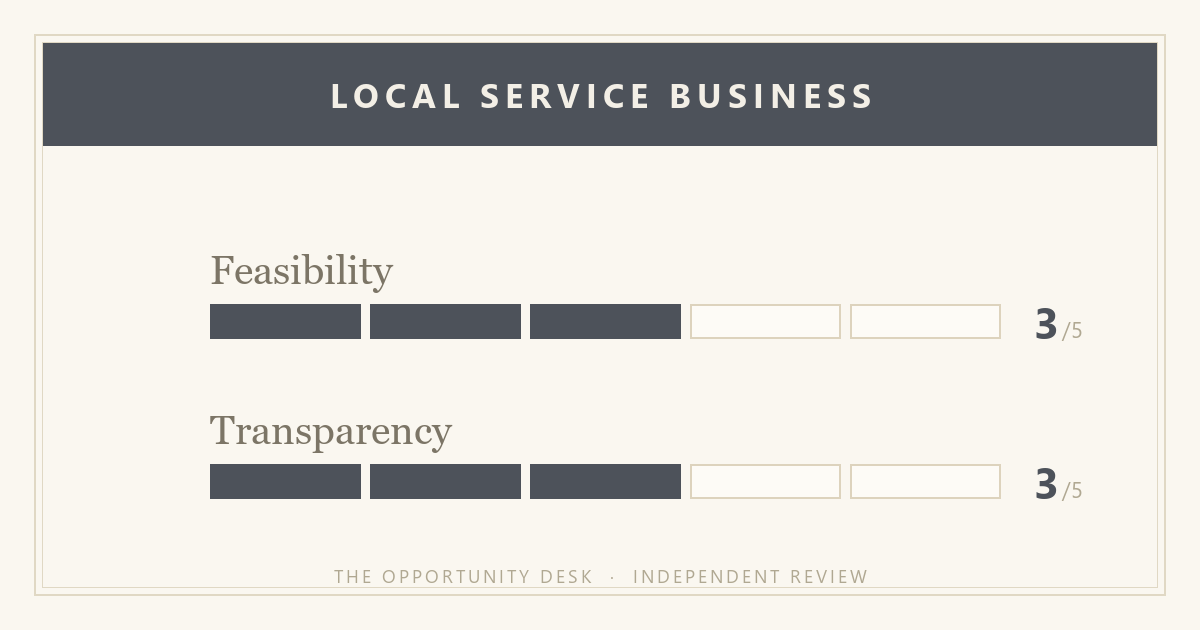
Feasibility: 3/5 — Kaleb went from $32K to $247K in 90 days, but he also mentions "I've never tried this hard in my entire life" and attributes gains to both Hormozi's tactics and to hiring a repair tech and implementing a custom ERP system. The video doesn't isolate which change drove which result. The revenue increase is real, but it's bundled with operational changes (new hire, new software, founder intensity) that would drive growth independent of the sales tactics, and one of the two centerpiece tactics (the VSSL) wasn't even in use yet by the 90-day mark. That makes it hard to know if a new entrant could replicate this without Kaleb's specific close rate or work ethic.
Transparency: 3/5 — Kaleb states gross profit margins (59% overall, 64% on repairs) and an average ticket range ($1,500-5,000 for repairs, $18-25K for replacements), but never discloses fixed costs, what he pays himself, or whether the 59% margin survives after labor and overhead. Core revenue and margin figures are given, and Kaleb is candid that the maintenance membership isn't converting well. Also that the VSSL hadn't been produced yet, but the lack of a net profit number or cash flow breakdown means we can't tell if this business is actually profitable or just generating revenue at a loss.