
Travis Nicholson: I made $35K with ChatGPT + Gumroad (Copy Me)
Travis Nicholson says he made $35,000 selling AI prompt guides on Gumroad, working one to two hours a week. He never states the time period, skips Gumroad's fees, and elsewhere in the same video cites his own total earnings as $30,000 - a number that doesn't match his headline claim.
Source: "I made $35K with ChatGPT + Gumroad (Copy Me)" — Travis Nicholson, published June 2026. Watch on YouTube →
THE OPPORTUNITY
Travis Nicholson says he made $35,000 selling digital products on Gumroad - primarily AI prompt packs and guides for Suno AI, a music generation tool. He claims this income came from products he created once with help from AI tools and now runs as a side business while working full-time, typically spending one to two hours a week on it.
HOW IT'S EXECUTED
- Find a problem you've personally solved (Nicholson used a problem he encountered using Suno AI - the tool wouldn't generate songs in the style of certain artists).
- Document your solution, using AI tools like ChatGPT or Claude to organize your knowledge into structured content, but adding your own unique process rather than generic AI output.
- Share free versions of your solution on platforms with algorithmic reach (Medium, YouTube, Reddit, TikTok) to build trust and drive traffic without paid ads.
- Create a paid "upgrade" of the free content - a longer guide, more prompts, better formatting, and list it on Gumroad with mockups, sample pages, and a low starting price.
- Use Gumroad's email capture to build a list, then send a four-email sequence offering more free value before soft-selling the full product.
- Create bundles of related products to increase average order value (Nicholson's eight-in-one bundle for $17 replaces individual $5-10 products).
WHAT'S CREDIBLE
Nicholson shows actual Gumroad analytics with specific monthly revenue figures, view counts, and conversion rates. His October screenshot shows 15,000 views and 334 sales at a 2.2% conversion rate, which is plausible for free-traffic content marketing. He transparently shows his product pages, pricing, and email sequences rather than just describing them. His claim that most income came after introducing bundles matches common e-commerce patterns - bundle sales did increase his average order value over single-product purchases. The underlying model is sound: create something once, distribute it digitally, use free content to build an audience, capture emails, upsell.
WHAT'S OMITTED OR OVERSTATED
He presents $35,000 as total revenue but never specifies over what time period. The phrase "since then" references "last year" but the actual span is unclear. Is this six months of earnings or eighteen? Revenue spread over a longer period is less impressive than he implies. He shows one month where he made $3,000 but does not show whether that is typical or an outlier. Inconsistent monthly income would change the reliability of this as passive income. He says he spends "one to two hours a week" but does not account for the upfront time required. Creating 20+ digital products, writing dozens of Medium articles, producing YouTube videos, and setting up email sequences is not a low-lift effort at launch. That time investment is buried. He claims "many mornings I wake up and I've already made over $100" but this is not backed by data showing how often that actually happens versus mornings with zero sales.
His success depends entirely on free organic traffic from Medium and YouTube. He does not address that both platforms have changed their algorithms and monetization policies repeatedly. Medium cut partner payouts significantly in recent years. Relying on platforms you do not control is a structural risk he does not name. He never mentions Gumroad's fee structure. Gumroad takes 10% plus payment processing fees. If he made $35,000 in sales, roughly $3,500 to $4,000 went to platform fees. Presenting gross revenue without mentioning platform cuts overstates take-home income. He says "people are becoming more comfortable purchasing digital assets online" but does not acknowledge that AI prompt packs and AI guides are among the most saturated categories on Gumroad. A search for "ChatGPT prompts" or "AI guide" on Gumroad returns thousands of nearly identical products. His specific niche, Suno AI, is small and may not support many sellers.
He attributes his growth from $800 to $3,000 per month entirely to bundles but does not show whether that revenue is sustained. A single viral video or article could spike bundle sales temporarily without indicating repeatable income. The email funnel he describes requires an email service provider for automation. He does not mention which tool he uses or whether there are costs associated with sending emails to a growing list. Free tiers cap at a few hundred subscribers. At scale, email tools charge monthly fees that would reduce net income. He says most platforms reward consistent posting regardless of follower count but does not acknowledge that Medium articles require a paid Medium membership for readers to access in full. Driving traffic to paywalled content limits reach unless readers are already Medium subscribers. That context is missing.
He advises creating products that solve problems but does not explain how to validate demand before building. He mentions Reddit and YouTube comments as research sources but gives no method for distinguishing one-off complaints from recurring pain points worth addressing. His own success came from writing about a tool that was new and trending. Suno AI launched in late 2023 and had a brief window of novelty. Replicating that timing with another emerging tool is harder than he suggests. First-mover advantage is a material factor he does not name. He says AI tools like Claude can create a digital product "from scratch" in less time than Canva but does not show an example of a product built that way or explain how to avoid the "AI slop" look he warns against. The line between using AI efficiently and producing low-quality content is unclear.
His advice to "teach before you sell" and share free content assumes the reader has expertise worth sharing. Many viewers do not. If someone has not already solved a problem themselves, there is nothing to teach.That prerequisite is glossed over. He presents 2.2% as a normal conversion rate but does not clarify whether that is views-to-sales or clicks-to-sales. Industry benchmarks for cold traffic converting to a $5-10 product are typically under 1%. If his 2.2% is views-to-sales and includes both free and paid downloads, the actual paid conversion rate would be lower. The math is ambiguous - elsewhere in the same video he cites a separate "1 to 5% of everyone that's clicking is purchasing" figure for a different traffic stage, without reconciling the two numbers. He claims his top sellers are freebies but does not explain the business logic. Giving away the most popular products for free may build a list but it does not directly generate the $35,000 he leads with. How much of that revenue came from upsells after free downloads versus direct paid sales is not broken out.
BOTTOM LINE
This is viable for someone who has already solved a specific problem in a niche where people are actively searching for answers and is willing to produce consistent free content to build an audience. It is not a low-effort path unless you already have the content creation habit and a platform with traction. If you can write or record regularly, tolerate platform algorithm risk, and are early to a trending tool or topic, the model works. If you are starting from scratch with no existing audience and no unique expertise, the time to revenue will be much longer than Nicholson implies. The $35,000 figure is meaningful only if sustained monthly income is in the $2,000+ range — and that is not demonstrated here.
OPPORTUNITY DESK RATING
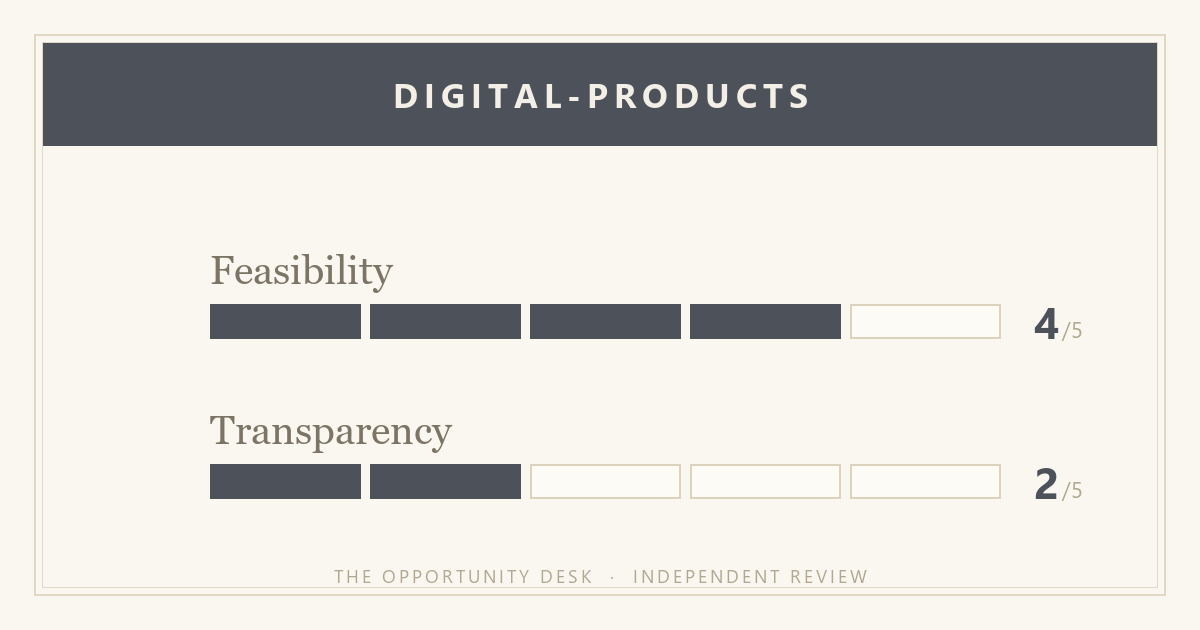
Feasibility: 4/5
The underlying business, selling digital products through content marketing, is proven and the tools are accessible. The model works if you can produce content consistently and solve a real problem.
Transparency: 2/5
Nicholson shows real analytics and product pages but omits time period for total revenue, platform fees, the upfront time investment, and whether the income is sustained or spiked by one-off viral posts. He also cites two different total-earnings figures ($35,000 and $30,000) within the same video without reconciling them. The "passive income" framing hides how much ongoing content creation actually drives sales.


