Side Hustle Nation's ATM Side Business: How Passive Is "$1,500/Month for One Hour a Week"?
This is a more honest and transparent pitch than most that we see. An operator running seven ATM machines describes a modest, genuinely real income stream, and is unusually candid about the parts that aren't passive at all.
Source: Side Hustle Nation - How He Makes $1,500/Month From ATMs (Working Just 1 Hour a Week). Watch on YouTube →
THE OPPORTUNITY
Will operates seven ATM machines as a side business, generating approximately $1,500 monthly in surcharge fees for roughly four hours of work per week. The model is straightforward: purchase ATMs for around $3,000 each, load them with $1,000+ in cash, place them in high-traffic locations, and collect $2–4 per transaction. He positions this as scalable passive income with potential exit value at 2.5x gross annual revenue.
HOW IT'S EXECUTED
You need four things before your first placement:
- Form an LLC and obtain an EIN
- Secure a business bank account willing to process ATM transactions — Will emphasizes this is the hardest part. Most national banks refuse due to historical money laundering concerns; you'll be calling local credit unions
- Purchase machines (Will uses Genmega 2500s at ~$3,000) through a processor like Prineta
- Negotiate location agreements with businesses, ideally those that are cash-only or underserved by their current ATM provider
The operations model splits into three bank accounts:
A. Vault cash (the money you load into machines)
B. Ttransaction income (the surcharge fees)
C. Savings
Will's partner handles the cash logistics — withdrawing from the vault account and refilling machines weekly. When a customer withdraws $200, that amount cycles back to vault cash; the $3 surcharge goes to income.
Contracts with locations run two to five years, which matters for eventual resale value. The pitch to businesses centers on local responsiveness: "I'll answer my phone, I'll fix it same-day, here's my cell number" which is differentiation through reliability rather than price.
WHAT'S CREDIBLE
The unit economics check out for small-scale operation. A barber shop doing 200 transactions monthly at $3 each generates $600, which is plausible depending on the neighborhood location. Will's seven machines producing $1,500 monthly suggests an average of $214 per machine, consistent with a mix of lower-volume locations. The 2.5x revenue multiple for selling routes aligns with service business valuations where customer contracts exist.
"Find the disgruntled customer" is good advice, these locations already have ATMs, so you're competing on service quality, not filling a void. The insurance calculation reflects genuine operator thinking: at $2,250 annually for two machines, he initially self-insured, reasoning he could lose one machine per year and break even versus paying the premium. Finding Coterie Insurance at roughly $1,080 annually represents real problem-solving. The acknowledgment that theft is "when they do it" rather than "if they do it" indicates someone who's actually dealt with reality.
WHAT'S OMITTED OR OVERSTATED
The $1,500 monthly figure for "about an hour a week" ignores significant up-front time investment. Will describes months of door-to-door prospecting, calling six or seven banks, getting rejected at locations, building websites and contracts. That setup time isn't factored into the hourly rate calculation. Once operational, yes, but the revenue-per-hour math only works after you've absorbed substantial unpaid acquisition effort upfront.
The dispensary goldmine narrative needs scrutiny. Will projects 5,000 transactions monthly at a dispensary location ($15,000 in customer withdrawals daily), which would generate $2,250 monthly at $3 per transaction. Compelling on paper, except he hasn't landed one in several years of trying. He mentions larger operators have people monitoring LLC registrations to claim these locations before they open. If the high-volume opportunities require resources he doesn't have, his accessible market is barbershops and soccer complexes. They're fine businesses, but the income ceiling is there.
The "passive" framing strains credibility at seven machines requiring weekly cash logistics. Will's partner drives a route to deposit and withdraw cash; Will handles machine servicing. They've split responsibilities to keep individual time low, but this is two people managing seven units. A quote from an operator with 400 machines: "you can kiss your vacations goodbye" suggests the model doesn't scale passively. You either stay small and hands-on, or you hire staff and shrink your margins.
The contract requirement for reselling the business later adds friction. Will now pushes for five-year agreements because they increase sale value, but a new operator pitching a five-year commitment to a barbershop he's never serviced is asking for substantial trust. Hhe might be more successful offering a trial period before the owner commits. The $45–50K exit value he projects assumes buyers will pay for those contracts, which depends on location quality, transaction history, and the contracts being truly transferable.
BOTTOM LINE
This works for someone willing to do unglamorous cold-call sales, capable of loading cash into machines regularly, and living in a market where credit unions will bank the business. Will's success stems from proximity (he can service same-day), persistence (months of door-knocking), and partnership (splitting logistics with a trusted friend). The income is real but modest at his scale. Growing it to replace a salary requires either landing the elusive high-volume dispensary or building a 20+ machine fleet, at which point the time commitment escalates significantly.
The business is viable if you enter with Will's expectations: supplemental income, local operation, genuine service delivery. It fails if you're chasing the "truly passive" narrative or banking on immediately landing premium locations. The appealing part is the asset value — the machines have resale value, routes have resale value, and you're building equity alongside cash flow. The unsexy part is everything else, which doesn't disqualify it, you just need to know what you're signing up for.
OPPORTUNITY DESK RATING
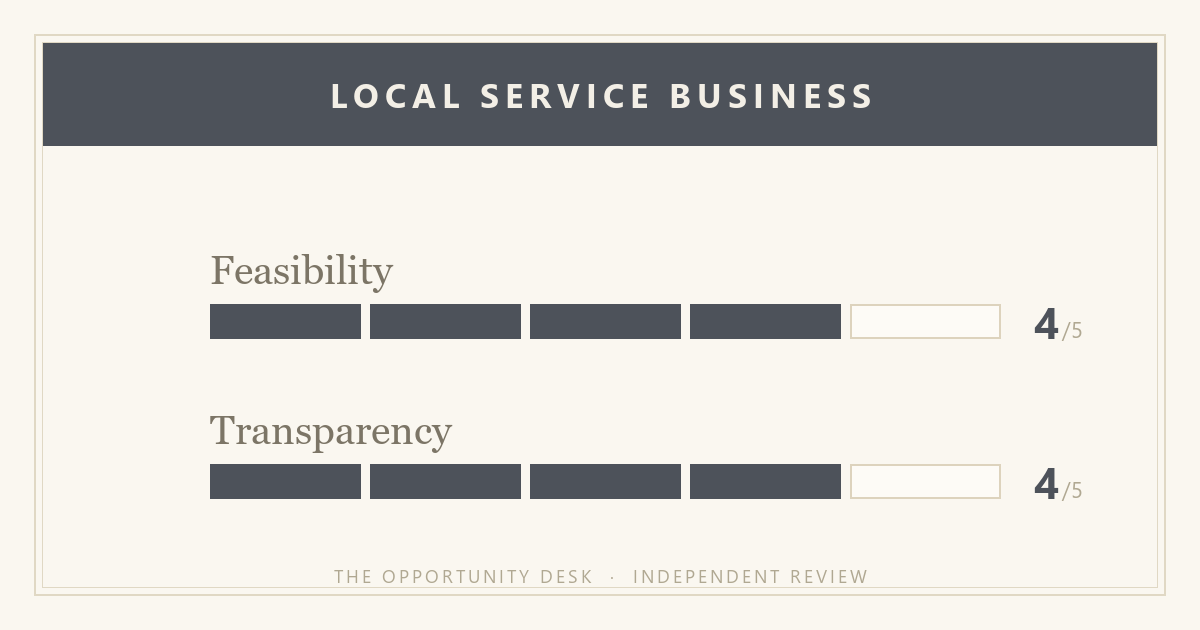
Feasibility: 4/5
The underlying business is sound for supplemental income, but scaling constraints are real. You're geographically limited by service radius, access to quality locations is competitive, and true passivity requires either staying very small or hiring. The 2.5x exit multiple provides a viable off-ramp.
Transparency: 4/5
Will is forthright about difficulties - the bank account nightmare, theft, failed dispensary approaches, and the limits of keeping it "passive." He doesn't obscure that his income comes from sustained work, not autopilot. The time investment framing could be clearer about setup versus maintenance phases, but this is one of the more candid pitches reviewed to date.