Meg Heckman, The Smartest Way to Start POD With Almost No Money
Meg Heckman breaks down a $630, three-month budget to launch a print-on-demand Shopify store, citing her $4.98 million in sales as proof the model works. She never says how long it took her to get there or what her current ad spend is, and her "break-even" math skips fulfillment costs entirely.

Source: "The Smartest Way to Start POD With Almost No Money" Meg Heckman, published August 2026. Watch on YouTube →
THE OPPORTUNITY
Meg Heckman, who says she runs a t-shirt brand that did $4.98 million in sales over the past 12 months, walks through what it actually costs to launch a print-on-demand Shopify store when money is tight. She frames the pitch around three resources: money, time, and effort - and argues you can start for under $30 in software costs if you're willing to stretch the timeline and do all the work yourself.
HOW IT'S EXECUTED
- Use free AI tools (ChatGPT, Claude) to research your niche, write brand copy, and generate 100 designs before paying for anything.
- Set up the designs in Canva's free plan, then launch a Shopify store during a promotional period ($1/month for three months, then $39/month).
- Connect Printify (free to use, no subscription) to handle product fulfillment, and install free or cheap apps for bulk editing, reviews, and email marketing.
- Run Facebook or Instagram ads in four-day cycles (Thursday through Sunday) at $12.50/day minimum, collecting data on which designs get clicks and sales.
- Turn ads off after each cycle, review performance, cut non-performers, and repeat until you hit break-even — the point where ad spend equals revenue.
- Once break-even, raise ad budget to buy more data and customers without losing money, aiming for profit as the next milestone.
WHAT'S CREDIBLE
The $4.98 million figure is theoretically plausible for an established print-on-demand brand with a large catalog and consistent ad spend. Heckman's breakdown of app costs matches current pricing for Shopify, Printify, and the tools she names. The framing around time and effort as hidden costs is honest. Free plans do cap usage, and her point that a smaller ad budget stretches the learning curve is accurate. Her emphasis on break-even as the first checkpoint before profit is operationally sound and more realistic than pitches that promise immediate returns.
WHAT'S OMITTED OR OVERSTATED
She never specifies how long it took her own brand to reach $4.98 million or what her current monthly ad spend is. Without those numbers, there's no way to gauge whether her early constraints actually led to her current scale, or whether other factors such as prior audience, industry connections, or a larger capital injection later bridged that gap.
She says the $12.50/day minimum is based on needing to test 100 designs, but Meta's algorithm doesn't distribute budget evenly across a catalog. So most of that spend will go to a handful of ads. She doesn't address how many cycles it actually takes to identify winners under those conditions. The $200/month ad budget assumes four cycles per month. She doesn't say what happens if none of those cycles produce break-even results. If ads don't work after three months, you've spent $630 with no revenue to show.
She mentions her brand has over 100,000 email subscribers but doesn't explain how those were acquired. Organic traffic and email growth at that scale typically require SEO, content marketing, or paid acquisition beyond the ad cycles she describes.
She doesn't account for product costs in her budget breakdown. Printify charges per item fulfilled. If you're testing ads and getting clicks but no sales, there's no product cost. But once orders start, fulfillment eats into revenue before you calculate break-even. She doesn't give a sample margin. The "break-even" she describes is ad spend equaling revenue, not ad spend equaling profit after fulfillment and Shopify fees. Those costs exist whether or not she names them.
She says Canva's free plan works but locks background removal and magic resize behind a $15/month paywall. If those features are necessary for production-ready designs, the free plan isn't actually free. She says ChatGPT's free plan caps image generation at "a couple a day" but admits there's no official number. If it takes a month or more to generate 100 designs on the free plan, that pushes your Shopify promo clock, you can't start the $1/month trial until designs are ready, and if prep takes two months, you've eaten into the window where the business could start covering its own costs.
She says her brand did $4.98 million in sales but never clarifies net profit. Revenue and profit are not the same. A high-revenue, low-margin business can look successful on a top-line number while barely breaking even or operating at a loss. She positions this as "the smartest way to start POD with almost no money" but doesn't compare her approach to other low-cost models. Is this cheaper or faster than starting on Etsy, Redbubble, or another platform with built-in traffic? She doesn't address that question. She says the goal is to hit break-even by month three so the business covers its own Shopify bill when the promo ends. But she doesn't say what percentage of beginners actually hit that milestone in that timeframe. If most don't, her budget is understated.
BOTTOM LINE
This is viable for someone with a few hundred dollars, a high tolerance for manual work, and realistic expectations about the learning curve. The budget itself is honest for the software and ad testing, but it assumes zero product costs during testing, doesn't clarify margins, and skips the question of how many cycles it actually takes to find winning designs under a constrained budget. If you're short on cash and long on time, this could work. But the pitch undersells how many people will spend $630 and three months without hitting break-even, and it doesn't explain how Heckman herself went from break-even to nearly $5 million.
OPPORTUNITY DESK RATING
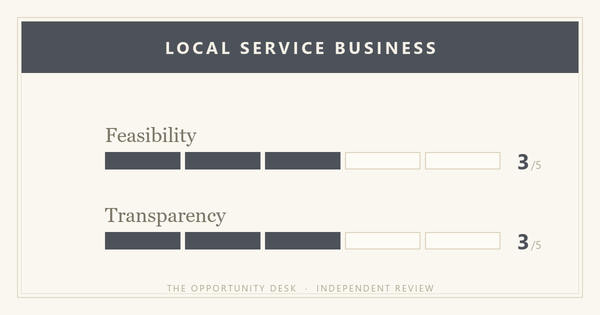
Feasibility: 3/5 — The underlying model works. People do run profitable print-on-demand brands, but the path from $630 in testing to multi-million-dollar revenue is left completely unexplained, and the budget assumes best-case product costs and margins.
Transparency: 3/5 — She's candid about the time and effort trade-offs and doesn't hide that ads cost money, but she omits fulfillment costs from the budget, conflates revenue with profit, and never clarifies how her own brand scaled past the break-even stage she describes.